
Starting an online merchandise business sounds exciting until you begin thinking about inventory, printing equipment, packaging, shipping, and unsold products taking up space in your home.
That is exactly the problem print-on-demand platforms are designed to solve.
Instead of purchasing hundreds of T-shirts, mugs, or hoodies before knowing whether anyone will buy them, you upload a design and have the product manufactured only after a customer places an order. The printing partner then packages and ships the order directly to the buyer.
Printify is one of the most recognizable platforms offering this service. It helps entrepreneurs create and sell customized products without owning printing equipment or managing inventory.
But how well does it actually work? Is Printify suitable for someone launching a first online store, or is it mainly useful for established sellers processing large numbers of orders?
This Printify review examines its product selection, pricing, integrations, fulfillment process, print quality, advantages, limitations, and overall value in 2026.
Affiliate disclosure: This article contains an affiliate link. We may receive a commission when you create an account through the link, at no additional cost to you. Our conclusions remain independent and are based on the platform’s publicly available features, policies, and practical suitability for sellers.
What Is Printify?
Printify is a print-on-demand platform that connects online sellers with a network of independent printing and fulfillment companies.
Unlike a traditional manufacturer that operates all its own production facilities, Printify works as the technology layer between the seller and multiple Print Providers. These providers manufacture products in locations including the United States, the United Kingdom, Canada, Australia, Germany, France, Poland, Latvia, the Czech Republic, the Netherlands, Slovenia, and China.
This structure gives sellers more flexibility. When creating a product, you can often compare several providers offering the same or similar item. Their production prices, shipping charges, locations, color options, average fulfillment times, and performance ratings may differ.
Printify currently advertises a catalogue of more than 1,300 customizable products. The selection includes familiar print-on-demand products such as T-shirts, sweatshirts, hoodies, mugs, posters, stickers, bags, candles, phone cases, children’s clothing, and home accessories.
You do not need to order inventory in advance. A product is manufactured after a customer buys it, helping reduce the financial risk normally associated with launching a clothing or merchandise brand.
if you are a seller interested in exploring the platform you can create an account here.
How Printify Works
The basic Printify process is straightforward:
- Create a Printify account.
- Choose a product from the catalog.
- Select a Print Provider.
- Upload or create your design.
- Position the design using the Product Creator.
- Generate product mockups.
- Add a title, description, price, and product variants.
- Publish the product to a connected store.
- Promote the listing and attract customers.
- When an order arrives, Printify sends it to the selected Print Provider for production and delivery.
Once a customer places an order through a connected sales channel, Printify processes it according to the order-approval settings selected by the seller. The Print Provider then produces, packages, and ships the product directly to the customer.
You remain responsible for designing the products, setting retail prices, marketing the store, and communicating with customers. Printify and its providers handle the physical manufacturing and fulfillment work.
This distinction is important. Printify makes operating a merchandise business easier, but it does not automatically bring customers to your store. Success still depends heavily on niche selection, design quality, pricing, product research, and marketing.
Creating Products With Printify
One of Printify’s greatest strengths is that it makes product creation approachable.
You do not need to understand printing machinery or manufacturing terminology before getting started. After selecting an item, you can upload an existing design and position it within the available print area.
Printify also provides product mockups that show how the finished item may look. Sellers can select mockup images for their listings and choose which image appears as the main product image.
The mockups are useful, especially when launching a store without professional product photography. However, sellers should remember that a digital mockup is still a representation. The exact print size, fabric texture, colors, and positioning can appear slightly different on a physical product.
For that reason, ordering samples is one of the smartest steps you can take before spending money promoting a new design.
Printify allows sellers to place sample orders, but samples are not free. They are charged at the regular product price, although Premium subscribers may receive the standard Premium discount on the product’s base price.
Paying for a few samples may feel inconvenient, but it can prevent much more expensive problems later. A sample allows you to check:
- The physical quality of the blank product
- The accuracy and sharpness of the print
- The size and position of the design
- The packaging presentation
- The approximate delivery experience
- Whether the product matches your brand’s standards
It also gives you an opportunity to take original photographs and videos instead of relying entirely on mockups.
Product Selection and Print Providers
Printify’s large catalog is one of the main reasons sellers consider the platform.
You can build a traditional apparel store around T-shirts and hoodies, but you are not limited to clothing. Depending on current availability, the catalog may include wall art, drinkware, stationery, accessories, home décor, bags, blankets, phone accessories, pet products, seasonal merchandise, and other customizable items.
The variety makes it easier to test new ideas without committing to large inventory purchases.
For example, a travel creator could sell destination-themed shirts, mugs, tote bags, and posters. A fitness brand could offer workout shirts, water bottles, gym bags, and motivational wall art. A small business could create branded clothing for employees without keeping boxes of uniforms in storage.
The Print Provider network adds another level of choice. Providers can differ in location, base product cost, shipping price, available printing methods, production speed, product variants, and performance.
That flexibility is valuable, but it also means sellers must do some research.
Choosing the lowest-priced provider automatically is not always the best strategy. A cheaper provider located far from your main customers may produce higher shipping charges or longer delivery times. Another provider may cost slightly more but have better performance scores, faster production, or more suitable product colors.
Printify publishes performance information that considers factors such as production quality, production speed, and stock reliability. These scores are updated regularly and can help sellers compare providers.
A sensible approach is to shortlist two or three providers, compare their total costs, and order samples before selecting the one that will represent your brand.
Print Quality: What Should Sellers Expect?
There is no single answer to the question, “Is Printify’s print quality good?”
Printify itself is the platform coordinating the order. The physical product is manufactured by the Print Provider you select. Because different providers use different equipment, products, inks, production processes, and quality-control systems, results can vary.
This is both a strength and a weakness.
The advantage is that you are not locked into one manufacturer. You can test several providers and move a product when another option offers better pricing, availability, or performance. Printify even has a Replace feature that allows sellers to change a product model or Print Provider while retaining important listing information.
The disadvantage is that two similar shirts produced by different providers may not be identical.
A responsible seller should never assume that every product in a large catalog will have the same quality. Read the product details carefully, review provider performance information, check garment materials, inspect sizing guides, and order samples.
You should also use high-resolution design files. Printify states that free reprints are generally not available when poor results are caused by low-resolution or unsuitable artwork.
The quality of the original design matters just as much as the printing provider.
Store Integrations
Printify can connect with several major eCommerce platforms and marketplaces.
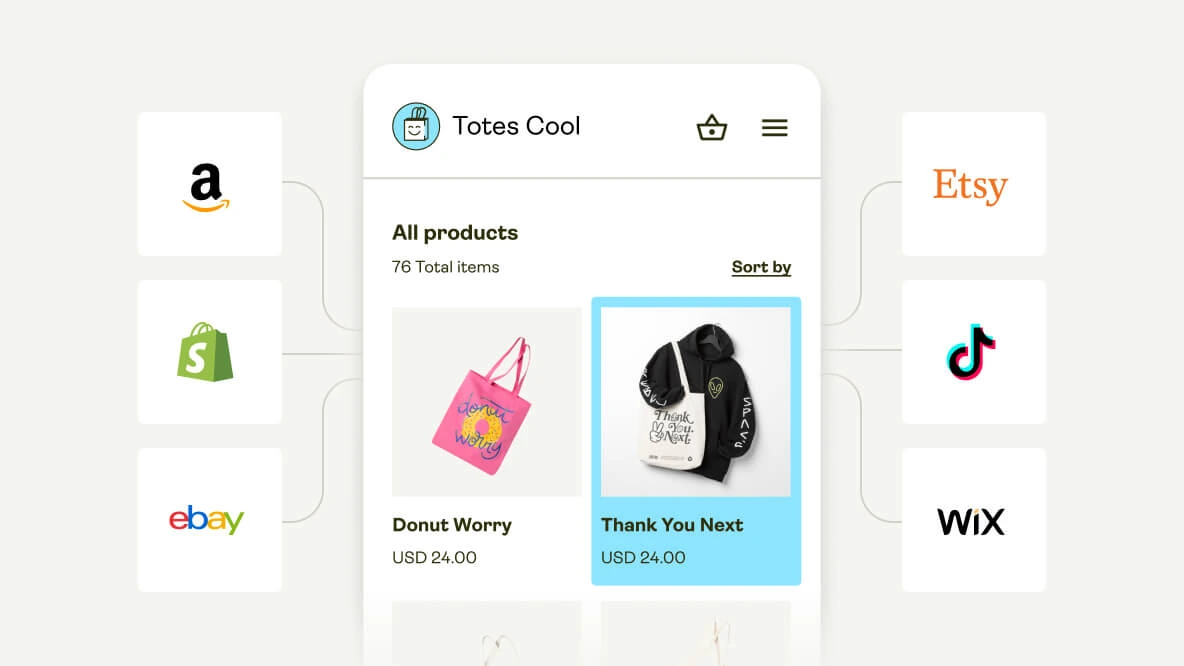
Its listed integrations include Shopify, Etsy, WooCommerce, eBay US, Wix, Big Cartel, PrestaShop, and other supported sales channels.
These integrations reduce the amount of manual work required to run a store. Products created in Printify can be published to the connected channel, while eligible customer orders can be imported for production and fulfillment.
The best platform depends on your goals.
Printify and Etsy
Etsy may be attractive to beginners because customers already visit the marketplace looking for creative, personalized, and niche products.
The disadvantage is competition. A generic slogan placed on an ordinary shirt is unlikely to stand out among thousands of similar listings. Etsy sellers need strong product images, focused keywords, appealing designs, and a clearly defined audience.
Printify and Shopify
Shopify provides more control over branding, store design, email collection, customer relationships, and marketing. However, you must generate your own traffic through advertising, search engines, social media, influencers, or an existing audience.
It is usually better for sellers who want to develop an independent brand instead of relying entirely on a marketplace.
Printify and WooCommerce
WooCommerce can be a good choice for publishers and entrepreneurs who already operate WordPress websites. It offers extensive customization and greater control, although installation, maintenance, hosting, and troubleshooting may require more technical confidence.
Printify’s WooCommerce connection can synchronize products and streamline order management once the store is properly configured.
Printify Pop-Up Store
People who do not already have a website or marketplace shop can also explore the Printify Pop-Up Store.
This option lets eligible creators launch a simple storefront hosted through Printify. The company promotes it as a way to start selling without separate subscription, listing, or transaction fees from an external eCommerce platform.
The Pop-Up Store includes tools such as a drag-and-drop editor, product mockups, graphics, and access to Printify’s design features.
It could be useful for:
- Testing a product idea
- Selling merchandise to an existing social media audience
- Creating products for a temporary campaign
- Launching without building a complete website
- Learning how print on demand works
Printify Pricing
Printify offers a Free plan, a Premium plan, and custom Enterprise arrangements.
The Free plan is listed at $0 per month and supports up to five stores with unlimited product designs. It provides enough access for beginners to explore the catalog, design products, connect a store, and process orders.
Printify Premium is designed for sellers who want lower product costs and additional growth features. As of July 2026, the monthly subscription is listed at $39, while annual billing costs $299, equivalent to approximately $24.99 per month. The plan advertises discounts of up to 33% on eligible new products and supports up to ten stores.
The important question is not simply whether Premium is cheaper. It is whether the product discounts will save your business more than the subscription costs.
For example, suppose your Premium savings average $2.50 per order. You would need approximately 16 monthly orders to recover a $39 monthly subscription. Everything saved beyond that would improve your margin.
Sellers with no consistent sales may be better off remaining on the Free plan. Once order volume becomes predictable, the Premium calculation becomes more attractive.
Prices and plan benefits can change, so check the current terms before subscribing.
Understanding Payments and Cash Flow
New sellers should pay close attention to how the financial side of print on demand works.
Your customer pays the retail price through your selling platform. Printify separately charges you for the product’s production and shipping costs.
That means the money paid by your customer does not always move instantly from the marketplace into your bank account and then to Printify. Marketplaces and payment processors may hold funds or follow their own payout schedules.
You therefore need enough available balance or credit to cover incoming Printify orders while waiting for your marketplace payout.
Imagine that you receive 30 orders during a weekend and each order costs $18 to produce and ship. You may need $540 available to send those orders into production, even though the customer payments are still being processed by your sales channel.
This cash-flow requirement surprises many beginners. Print on demand removes the need to purchase inventory, but it does not eliminate the need for working capital.
Production and Shipping
Printify states that most orders are shipped within approximately two to seven business days after being submitted, although production times vary according to the provider, season, order size, and product availability.
Shipping time is separate from standard production time. The total customer experience includes:
Order approval time + production time + shipping time
Sellers should avoid promising unrealistic delivery dates. Holiday periods, supplier shortages, unsuccessful quality checks, unusually large orders, and carrier delays can extend fulfillment.
Shipping prices also vary considerably between providers and destinations. A product that looks inexpensive based only on its production cost may become less competitive after shipping is added.
Printify provides shipping-rate information for individual providers, allowing sellers to compare available methods before publishing products.
Order Routing can help when a selected provider is unavailable, out of stock, temporarily closed, or experiencing significantly longer production times. When enabled, the system can route an eligible order to another provider according to the seller’s settings.
This can prevent lost sales, but sellers should understand that changing providers may produce small variations in print appearance, product characteristics, or cost.
Returns, Refunds, and Customer Complaints
Because print-on-demand products are manufactured specifically for each order, Printify does not generally support returns or exchanges when a customer chooses the wrong size, selects the wrong color, or simply changes their mind.
For damaged products or manufacturing errors, Printify says it can offer a free reprint or refund when the problem is reported within 30 days of delivery with appropriate photographic evidence.
This makes it essential to publish a clear store policy.
Your customers should understand:
- How sizing works
- Whether exchanges are accepted
- What happens when they provide an incorrect address
- How quickly they must report damaged products
- What photographic evidence may be required
- Which situations qualify for a replacement or refund
Good size charts and accurate descriptions can prevent many avoidable complaints.
Printify’s Main Advantages
1. No inventory commitment
Products are manufactured after an order is received. You can test ideas without purchasing hundreds of units upfront.
2. Large product catalog
With more than 1,300 advertised products, sellers have plenty of room to expand into new categories and seasonal merchandise.
3. Multiple Print Providers
You can compare providers based on location, pricing, shipping, production speed, and performance instead of relying on one manufacturer.
4. Beginner-friendly product creation
The Product Creator and mockup tools make it possible to prepare a listing without specialist manufacturing knowledge.
5. Useful eCommerce integrations
Connections with Etsy, Shopify, WooCommerce, Wix, eBay US, and other platforms can automate important parts of order processing.
6. Free entry plan
You can explore Printify and start creating products without paying a monthly subscription.
7. Potentially attractive margins
The ability to compare providers can help sellers find competitive production costs, particularly when order volume makes Premium discounts worthwhile.
Printify’s Main Disadvantages
1. Quality can vary between providers
The network model offers flexibility, but product quality and printing consistency depend on the provider you select.
2. Samples are not free
Testing several products and providers can become expensive because sample orders are charged at the applicable product and shipping prices.
3. Shipping calculations can be complicated
Different products may come from different facilities, creating separate shipping charges or packages.
4. Sellers need working capital
You may have to pay Printify’s production costs before receiving your marketplace payout.
5. Limited returns for customer mistakes
Printify generally does not cover returns when customers choose an incorrect size or change their minds.
6. Print on demand is highly competitive
Access to production tools does not guarantee sales. Successful sellers still need original designs, effective marketing, strong branding, and reliable customer service.
Who Should Consider Printify?
Printify may be a good option for:
- First-time print-on-demand sellers
- Artists and graphic designers
- Bloggers and content creators
- YouTubers selling audience merchandise
- Small businesses creating branded products
- Etsy sellers testing niche designs
- Shopify entrepreneurs building merchandise brands
- Website owners adding physical products
- Marketers who understand paid advertising
- Organizations producing items for events or communities
It is particularly attractive to people who want a large selection of products and the freedom to compare several fulfillment providers.
Who Might Prefer Another Solution?
Printify may not be the ideal choice for businesses that require identical production from a single facility, luxury-level custom packaging, complete control over every stage of manufacturing, or guaranteed delivery dates.
A company selling premium products at high prices may prefer to work directly with a carefully selected manufacturer. Similarly, a local business serving customers in one city might find that a nearby printer offers faster service and easier quality control.
Conclusion: Is Printify Worth It in 2026?
Printify offers one of the most accessible ways to test and launch a customized-product business without buying inventory or managing fulfillment personally.
Its greatest strengths are its extensive catalog, large provider network, useful store integrations, approachable product-creation tools, and free starting plan. Sellers can compare production partners, experiment with new products, and build a store without making the financial commitment required by traditional manufacturing.
Its flexibility also creates responsibility.
You must evaluate providers carefully, order samples, understand shipping costs, maintain enough working capital, and set realistic customer expectations. Product quality is not automatically identical across the entire network, and Printify cannot replace good branding, useful market research, or effective promotion.
For a beginner willing to learn and test products methodically, Printify is a practical platform. For an established seller, its provider choice and Premium discounts may help improve margins and support expansion.
The best way to judge the service is to create a free account, explore the catalog, compare providers, and design a few products before making a larger commitment. Explore Printify and start creating your first products
Creating an account is free, and no inventory purchase is required to begin designing products.

